Album Review: Kuniva – A History of Violence Vol. 2

by Apu

hiv

8/10

Coming back from doing a tour with a couple of his group members and stealing the show more often than not on D-12’s Devil’s Night Mixtape, Kuniva has gone solo again with the follow up to his official debut, A History of Violence. Released about a year later than originally planned, this project was pushed back until 2016 because of his work with D-12.

Before I go any further, I advise all 3 of you who are reading this to check my recap of A History of Violence (Vol. 1). I promise I’m not saying this [entirely] as a plug for views!

The first thing that can be said about this album is that overall, it is much more powerful than its predecessor. It’s evident even from the release of the lead single, “Dear Uncle”, that Kuniva approached making this album from a totally different perspective. It’s more heartfelt, thoughtful, and passionate. There’s nothing here that has the sort of carefree, almost ignorant attitude of “Born This Way” or “Where I’m From.” The entirety of the album is more mature and artistic. The two years Kuniva spent working on this left him a more seasoned artist, let alone emcee.

With this project, Kuniva put a larger focus on songwriting, more so than just rapping and lyricism. In fact, the straight “lyrical miracle” lyrics are less prevalent on many of the songs; for the most part, he opted towards writing songs with a message and focused less heavily on the rhymes and wordplay. That is probably my biggest gripe (well, actually, my only grip) with the album…and even then, it’s not really that big of an issue, because it’s not like Kuniva dumbed anything down, and there were still several instances where he did come with the battle lyricism that he’s known for. He’s shown the caliber of his lyricism on each of his previous projects, and just shifted focus on this. There was less room for it. He had something that he wanted to make sure he got across this time, and didn’t risk sacrificing the message with unnecessarily complex rhymes or metaphors.

The hooks are noticeably stronger, more present, and in many cases more melodic than they were on Kuniva’s previous material, which is artistic growth that I’m personally very glad to see. A stronger hook is what separates a good rap from a good song. He also started playing with his flow a bit. He had shown flashes of implementing double time flows on D-12’s comeback song “Bane” but since then kept it a little simpler on the D12 mixtape. However, from the very first track on this project onwards, we get to hear him weave in and out of different pockets in a way that I honestly didn’t expect. His flow has become crisper, and he’s managed to make it sound as though it’s both more precise and more relaxed at the same time.

Kuniva also started using his delivery to add to the buildup of his verses to give a more dynamic feeling towards the songs. On many of the tracks, he would start adding more of an edge to his voice as the verses went on, which helps keep the listener not simply engaged, but nearly clinging onto the words he’s saying. The majority of this album consists of very personal music, detailing the difficulties he’s had in his life as vividly as the best of them. His delivery matched the pain that is written so well that you would think he was sitting in a psychiatrist’s room recounting it as opposed to just rapping pre-written lyrics into a mic. I firmly believe that Kuniva’s delivery is one of the most impactful out right now. At times on this project his delivery, paired with the intensity of the stories he told in his lyrics, could figuratively kick you in the stomach.

My son’s looking up to me more, watching my every move,
Trying to mimic his dad, I try not to show him my tool,
He’s asking questions now, fuck I’m supposed to do?,
Finally told him what happened to Bugz and Uncle Proof,
The pain of explaining the real, leave you with screws loose,
To be able to watch your homie murdered on Youtube.
(Mama I Tried)

That’s not to say that the entire album is full of heavy subject matter. Songs like “Ride Slow,” “All I Know,” and “Trouble On My Mind” serve as Kuniva’s way of giving the listener something easier to listen to. At the same time, they still manage to capture the [relatively] lighter side to Kuniva’s life, rather than being just filler tracks for people who don’t want to listen to such serious music. They detail Kuniva’s life on the block, largely leaving aside the topics of personal strife and police brutality. They definitely don’t feel out of place though; in fact, they make the album feel more fleshed out. Block Symfany and Mr. Porter do a great job at offering production that flows well from track to track, and making each song settle in well. Each of these tracks, incidentally, are the only tracks with guest rappers on them. I personally feel as though Kuniva’s verses on these tracks vastly overtake the guest verses, who were strong in their own right. I do want to say that I’m relieved that the chemistry between Denaun and Kuniva still exists, and I look forward to the Brigade project that they announced in the outro of “Trouble On My Mind.”

The final track, “End of the Beginning,” has a small interlude between verses where Kuniva mentions how he’s found that people don’t really know that he’s his own person outside of D-12, and that he needs to show people who he is by himself. The production (offered by Block Symfany and Mr. Porter) help separate him from the devious D12 sound overall, and allow him to develop his own persona through his soul-bearing delivery and lyrics, which have become possibly the most vivid and deep out of anyone in his group aside from the obvious member. If there was something he could have released that would show people what he has to offer, this is it. This is the project that he needed to get people to stop using their bias against his group as a reason not to take him seriously. He succeeded in creating a cohesive project that puts on full display who he is as an artist and emcee. It is not a perfect album, but he has cemented who he really is behind his group persona, and he can keep building from there, which is what the phrase “end of the beginning” seems to imply.

Too often, you’ll see somebody release a sequel to an album and have it be essentially the same thing. No advancement in sound, no change in content…nothing different is offered. It’s basically just an excuse for an artist to not evolve and come with the cop-out of “but…but yeah but this is just the next part, it doesn’t make sense to change anything!” This album is a sequel done right. Kuniva uses this album as an opportunity to expand on what he was talking about in Vol. 1. He carries more of a narrative throughout it, aided by the interludes. It’s almost like he had the first disc serve as the prelude to his life story, where he gave bits and pieces, and he decided to dig deeper on this. While the lyricism may not be as complex, as a full body of work Vol. 2 absolutely dwarfs Vol. 1, and stands by itself as a great project.
Retrospective Review: Movies for the Blind, by Cage

by Dustin

mftb

Halloween is always a fun time of the year. The kiddos are out in spooky costumes collecting enough candy to become diabetic at eight years old, young adults are out in costumes slutty enough to make a stripper wince, and everyone is generally just out to have a good time. More importantly for this site however, there’s also a huge array of horror themed hip-hop out there to fit the mood of the season. We’re not talking about struggle-Juggalo horrorcore however. What we want to discuss is the artists that went deeper, combining horror elements with conventional hip-hop to create near-movie like albums.

Welcome to Extraordinary Nobodies’ first ever Halloween Week, where we will have a look at four of our favorite horror inspired albums for an entire week leading up to Halloween (though surely you have figured that out by now).

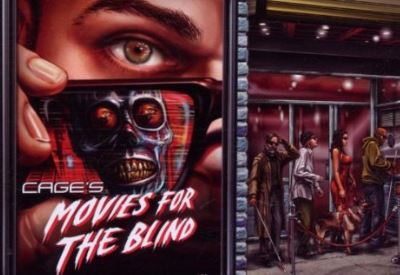
The first album on the menu is perhaps the least Halloween-flavoured of the bunch, but it’s got one foot firmly planted in the horror genre. Cage’s Movies for the Blind, released in 2002, combined shock rap with New York hip-hop in a way not many had attempted. Though he’s probably most notorious for a short lived beef with rap megastar Eminem, Cage’s first two releases are regarded by many as underground classics. Movies for the Blind started it all, and it’s a record that will leave you feeling utterly disgusted in the best way possible.

Lyrically, Movies for the Blind is the ultimate channeling of rage, drug abuse, and mental illness into bar after bar of tantalizingly shocking lines. Setting the tone is an album opener with Cage expressing an unbridled affinity for PCP and destruction. The album doesn’t quit either, with jump-scare like lyrics woven into even the most New York sounding tracks to keep you on edge. No content is off the table on this record. Murder, suicide, and violence find themselves as staples on what is a freak-show of atrocities. Dips into the norm are rare, but when they do happen it serves as a necessary break from the amazingly grotesque images Cage paints with his words.

Blue collar to corporate blessed the unfortunate,
Like when I put my foot down that bitch still aborted it,
Stuck the canister under my jacket like the lucky one,
‘Uh, sir you can’t leave with that,’ bitch this my fucking son!
(Too Much)

Unlike Hell’s Winter, which saw Cage take a more introspective approach to his music, Movies for the Blind lacks any form of self-awareness. It is an album with an emcee at his most unhinged, unloading rage and hate at anyone who will listen. It’s beautifully executed, and forces you to feel a level of discomfort that most horrorcore albums simply haven’t been able to achieve.

His charisma is also undeniable. It gets to the point that he nearly comes across as a sociopath.

I’m a suicidal failure, look my life’s a failure,
I can’t make it in rap, even my birth’s an error,
Do what I can to catch a quick death,
But I’m meant to be here and that’s the fuckin’ hell I live with.
(Suicidal Failure)

Interestingly, the production on Movies for the Blind is relatively subdue and typical for the underground New York scene at the time. The album featured production primarily by DJ Mighty Mi, but also the likes of El-P, Necro, and Camu Tao (plus a handful of others). With the lineup, it’s no surprise that the sound is so distinctly east coast. Movies for the Blind fools you into nodding along with the gritty production, while throwing lines about suicide and death in your face. The contrast is absolutely wonderful to experience; moreover, the instrumentals are brilliantly cohesive throughout.

Movies for the Blind may not be the ultimate Halloween record, but there are qualities to it that definitely make it a terrifying listening. It’s quite interesting how this album plays out like a series of short snuff films. It’s more disturbing than scary, but it remains as grimy today as it was 14 years ago upon release. Movies for the Blind is also a gem from a time where Definitive Jux and Eastern Conference (the latter of which would release the album) were just beginning to take over the New York underground scene. Whether you’re interested in records from that era, or just looking for something gory to celebrate Halloween, Movies for the Blind remains an underground classic that is wholeheartedly recommendable.

Not for the faint of heart, however.

Album Review: Danny Brown – Atrocity Exhibition

by Dustin

ae

9/10

If you’re a hip-hop fan and you don’t know who Danny Brown is, there’s a good chance you’ve been living under a rock since 2011. The Detroit emcee is known as quite the character, bringing an insurmountable level of energy to every song he touches. After jumping to Warp Records, Danny has finally released his follow up to 2013’s Old. Atrocity Exhibition.

And yes, that is a Joy Division reference.

On this record, Danny Brown is a rock-star in every sense of the term. He’s a boisterous character with no fear of expressing his affinity for drugs and alcohol; however, the beauty in Atrocity Exhibition is his ability to explore the consequences of the lifestyle he lives. Danny may be one of the few rappers who will boast about his drug use on one track, and then turn around and smack you with the honest truth about the problems this causes him on the next. Lyrically, he is completely on point. Atrocity Exhibition still has the same zany personality that made XXX and Old unique, but it’s also a highly introspective release. His lyrics are upfront and truthful, depicting a lifestyle that many couldn’t begin to imagine.

Everybody say, you got a lot to be proud of,
Been high this whole time, don’t realize what I done,
Cause when I’m all alone, feel like no one care,
Isolate myself and don’t go nowhere,
Smoking blunt after blunt, ’til my eyes start burning,
Hennessy straight got my chest like a furnace,
Drowning frustrations in a ocean of sin,
Thinking irrational, I have no emotions.
(Downward Spiral)

What stands out most about Danny Brown’s vocal performance on this record though is his flow. The man can rap on anything, plain and simple. For example, both the opening track “Downward Spiral”, and the song “White Lines” both have instrumentals that sound as if they should be impossible to ride… Yet, Danny finds a way to make it sound as easy as breathing. It’s really something to behold, and his ability to do this is on display here more than any previous album.

Which brings us to the instrumentation itself.

The production on Atrocity Exhibition is a really a unique experience. Provided by the likes of Paul White, The Alchemist, and a few others, the instrumentation on the album is unlike any other. There are elements to the production which feel distinctly Detroit, yet the overall sound is so off-the-wall that it’s hard to Atrocity Exhibition to any single influence. There are tracks like “Downward Spiral” that feel so heavily influenced by Joy Division (as the title would lead one to believe), and then more conventional instrumental like “Pneumonia”.

In the broader sense, everything works well together even with the vast stylistic variation. It feels hectic in a good way, and that’s exactly what’s to be expected from Danny Brown.

Atrocity Exhibition is special. It’s special first and foremost because it’s a great album, but there’s also something wonderful about seeing Danny Brown realize his potential. His previous releases have all been good in their own respect, but Atrocity Exhibition feels like so much more. It’s the type of album that pushes boundaries without being recklessly abrasive. Its execution is brilliant in the sense that it’s experimental, yet familiar enough to appeal to a larger base.

So my task,
Is inspire your future with my past,
I lived through that shit,
So you don’t have to go through it,
Stepping stones in my life,
Hot coals,
Walk with me.
(Hell for It)

Atrocity Exhibition may feel like a fever dream, but it is one that you will never want to wake up from. As a hip-hop fan, this record is a can’t miss album. Danny Brown has released one of the most engaging, unique, and gritty records of 2016. It’s certainly worth your time, and potentially album of the year material.

Album Review: Niku No Sekai – Flesh World Vol. 1

by Dustin

fleshworld

7.25/10

For nearly eight months we have regularly been reviewing albums here at Extraordinary Nobodies. Between our standard reviews of new releases, and the brand new “why was it good” retrospective category, it’s safe to say that we really love reviewing music. Yet, if one was to sort through our review archives they’d notice something odd… We have reviewed zero instrumental albums! This seems like a bit of a tragedy, as instrumental releases have been a big part of hip-hop forever.

Yet, the first instrumental album we’re going to have a look at isn’t even necessarily a hip-hop release! It is more of an ambient record, but it shares a lot of elements that instrumental hip-hop fans will be familiar with! This is particularly true for those who are interested in the alternative side of production. Plus, we do what we want. Fuck genres.

Moving on…

The album in question is Flesh World Vol. 1, a collaborative effort between two established artists (of SCRTS and Chinatown’s Pormer) released under the name Niku No Sekai. This project came out under the relatively young DOOMTRIP Records, a label which specializes in cassette based releases (you should follow them on twitter, sometimes they do awesome download code giveaways). Flesh World Vol. 1 was recorded on new years day, and saw release on DOOMTRIP in April.

So we’re a little behind the times here, but again, we do what we want.

Flesh World Vol. 1 is perhaps one of the most atmospheric releases to come out this year. The overall vibe to the tape is very chilled out, spacey, and slightly unnerving. It is not a long release by any means, but the sound is very cohesive throughout. Those who are already acquainted with ambient releases will most likely love Flesh World Vol. 1. It sounds like space. Listening to this album is like taking a trip through the galaxy while stoned.

The use of distance and beat changes on Flesh World really gives it life. Five tracks feels more like seven or eight, and there is a tangible environment with every second of playback. Though it’s ambient, the record isn’t afraid to grab your attention and force you to focus. The opening track, “WW4”, is a prime example of this. It has some really interesting switch-ups; moreover, the track is over ten minutes long but doesn’t feel dull for a second.

It is a dense piece of art. Don’t mistake “ambient” with “empty”, because this tape is immensely dense listening. Flesh World Vol. 1 is a record that will eventually demand your full attention, even if it does also make excellent casual listening. It is musically interesting enough to be much more than simply background noise. It certainly feels like there is a new sound to discover with every subsequent listen.

There are just so many things happening at once. It is a delightful and fun chunk of material to sink your teeth into.

For the hip-hop fans reading this blog wondering if they should give this tape a listen, yes, you definitely should. If you’re a fan of the stoned-out sound found in the cloud rap scene, this tape is probably going to be right up your ally. It’s a more developed sound as a product of needing to stand out without vocals, but there are clear similarities. Give it a listen, you probably will not be disappointed. Maybe you’ll even discover a new genre that you’ll enjoy.

Album Review: clipping. – Splendor & Misery

by Dustin

sm

8.5/10

It definitely seems as if we’ve written about clipping. a lot, but they’re one of the most active and unique rap groups out current. Who can blame us? Anyway…

To say that Daveed Diggs is popular right now would be an understatement. Fortunately, for fans of the Los Angeles based experimental rap trio clipping., he’s not abandoned his work in the world of weird. With an EP (Wriggle) already under their belt for the year, clipping. is back again with a full length followup to 2014’s CLPPNG. Released under Sub Pop Records and popular experimental outfit Deathbomb Arc, Splendor & Misery looks to keep clipping.’s hot-streak of releases at full steam.

With Splendor & Misery, clipping. took a step in a different direction from previous releases. The album follows the story of the sole survivor of an uprising, his life on an interstellar transport ship, and his relationship with the on-board computer. The concept is unique, and provided Digg’s the opportunity to flex his storytelling ability at every turn. He flawlessly maneuvers over the wild production, proving time and time again that he is one of the more versatile emcees in hip-hop. Tracks like “Baby Don’t Sleep” are beautifully unnerving, and it big part of this is Daveed’s vocal control and delivery. All in all, a wonderful vocal performance throughout the entirety of Splendor & Misery.

No home, you’ve been there,
Clearly off safety,
No destination,
No time for waiting,
Saviors are fiction,
Memories fading,
like ghosts, ghosts, go.
(Baby Don’t Sleep)

The production is basically what is to be expected from a clipping. album. It’s abrasive, loud, and fuzzy. The main difference on Splendor & Misery is that the instrumentals tend to be more spaced out than a lot of their previous work. Given the concept of the album, this is completely understandable and sets a well defined mood behind Deveed’s vocals. Atmosphere is the main strength of the production on this album. Though it might not necessarily carry that touch of traditional hip-hop the group is known for, the instrumentation is well execute. Hudson and Snipes rarely disappoint.

Though the album is a fantastic piece of art-rap, Splendor & Misery does have one minor flaw. There was a single moment which did not feel as though it fit the overall sound of the record. “Story 5” . Coming off a long run of incredibly cohesive work, the acapella felt very out of place. Unlike the previous “story” tracks on clipping. releases, it was not a standout track; regardless, It is still a pleasant listen and quite interesting, but in the grander picture of Splendor & Misery it was a jarring shift in sound.

Listeners who go into Splendor & Misery expecting the heavy hitting blend of conventional rap and noise may be in for a bit of a shock. This album is definitely a departure from the norm for clipping. as a group. Splendor & Misery should be approached as a conceptual art album, and not put in the same category as their previous works. Fortunately, for those who find themselves missing the sounds clipping. played with on previous releases the EP from earlier this year is jam packed with heavy, easier to digest songs.

This ain’t healthy to be held to blame,
Once you help me, now you abandon me,
What you’re tellin’ me by not tellin’ me?,
Anything, anything,
I’d give anything if you’d say my name,
Don’t you play with me, it’s an emergency.
(Break the Glass)

Don’t discredit Splendor & Misery for that reason, however. This album seems to be the moment that clipping. really discovered who they are as artists. From a conceptual standpoint this is the groups strongest effort. It was an absolute treat to see them tapping into some hidden potential. They took a risk with a release that is unconventional even for clipping., and it paid off with a solid final product.

Album Review: Ka – Honor Killed the Samurai

by Dustin

HKTS

8.75/10

It seems as if Ka has been on a roll since his debut solo album release in 2008. The gritty Brownsville emcee has totaled three solo albums (prior to Honor Killed the Samurai), two extended plays, and a collaborative album under the name Dr. Yen Lo. All have been met with positive critical reviews, and have garnered him an impressive underground fan base. As mentioned, he’s recently released Honor Killed the Samurai. This is his first full length solo album since 2013’s The Night’s Gambit, but he’s kept fans eagerly anticipating it with collaborative efforts and a handful of singles.

It’s finally here however, and it definitely lives up to the standard Ka has established throughout his discography.

When approaching any of Ka’s work, it should be expected that you will have to rewind and replay tracks multiple times to catch all the little details. This is true for Honor Killed the Samurai. With the focus being primarily on story telling lyrics, it isn’t the type of album that one can digest quickly. There is a lot of meat to chew on, and honestly this makes it quite wonderful to revisit. Ka’s presence on the album is most similar to that of a spoken word poet.

I strained to obtain so I could give more,
Most dangerous when there was nothing to live for.
(Conflicted)

Additionally, the production on Honor Killed the Samurai provides a splendid backdrop. The instrumentation feels relatively minimal; however, it’s quickly evident that it was the perfect choice for the overall feel of the album. There’s a degree of consistency to the production that creates a wonderfully cohesive environment behind Ka’s vocals. Though the production is minimalistic, it is a beautiful simplicity. All the tracks sound smooth, there is not an abrasive moment in the duration of Honor Killed the Samurai.

At the end of the day, Ka is the definition of a rapper’s rapper. Those obsessed with storytelling and complex (yet coherent) rhyme schemes will fall in love with this album. He’s immensely talented at painting a vivid scene, and he oozes technical writing ability. That being said, if you’re looking for an absent minded listen (which there is absolutely nothing wrong with), this is not the album for you. The focus is so narrowed on vocals that the listener has to be prepared to pay attention. It’s a rewarding listen, but not an easy one.

So I stood on mine, during the hoodest time,
Was a nightmare, felt like life here was as good as dying,
We was born in the thorns, few arose,
Once a town’s noose, now in soundproofs pursuing golds.
(Mourn at Night)

In a moment of stunning unprofessionalism, it seems fitting to close this with a statement aimed at the New York Post. If you cannot separate the music of a highly regarded story-teller from their personal lives, that is your issue. Do not attempt to write a smear piece on the artist. Simply because Ka writes about things street relate (perhaps things he’s seen, or grown up around), does not make him any less of a firefighter. He’s doing a job most are not brave enough to do, and should be celebrated as such. Not shamed for producing art that many love.

To the fans who voiced their displeasure, kudos. The author at the New York Post showed so little journalistic integrity, and it was beautiful to witness fans standing up for an artist over an injustice. Hopefully those who stood up for Ka also go out and support this project. Honor Killed the Samurai is very much worth the purchase.

Retrospective Review: A History of Violence, by Kuniva

by Apu

HOV

On December 16, 2014, Kuniva released his official debut studio project, A History of Violence. It followed a long stream of mixtapes (Retribution, the Midwest Marauders series, and the Lost Gold mixtape). Unlike the music that was on the mixtapes, Kuniva used all original production (primarily handled by Block Symfany, a production team composed of Rio Da Ghost and T.Boyd out of Michigan), and made actual fleshed-out songs, rather than just long verses and freestyles. Overall, it’s a very solid solo offering. It set the stage for him to grow and dig deeper in his later material.

The best part of this project to me is how Kuniva put it together. It sort of sounds like he sequenced the album very deliberately. The first 4 tracks seem like they’re from the perspective of a younger, more rowdy Kuniva. Those tracks tend to celebrate the street life. It opens up with the posse cut “Michiganish”, featuring Aftermath artist Jon Connor, Mass Appeal’s Boldy James, and Detroit legend Guilty Simpson. It starts things off fairly simply, being a competitive cypher of sorts. The following few songs, “Born Like This”, “Where I’m From”, and “Baileys In Bangkok,” all have a similar sort of vibe. They’re cocky and rowdy. They sound a little ironic and tongue in cheek, almost as though Kuniva was trying to rap the way a younger kid would rap. The content and the way it’s done makes me think he was talking about the street life, from the perspective of a kid living it, rather than someone reflecting on it.

Then comes “Derty Headz”, which is a very powerful song dedicated to fans of his and D-12. It has an anthemic hook and verses that drop all sorts of history about his career. He talks about Proof recruiting him for the group, the beef they’ve had, and the adversity they’ve faced from within since Proof passed. This song is the major turning point in almost every way. Here, flashes of reflection and maturity start to show up. From track 6 onwards, it seems to shift to his perspective now as a man nearly 40 years old after having seen massive success with his group, mournfully reflecting on the hard times in life but looking ahead with a drive to keep moving now that he’s out. “Light Work” and “Where The Hoes @?”, both offer fiery production and strong verses delivered with the hunger and confidence of a man who has seen his fair share of hardship. The title track, which is quite possibly the most personal and poetic song Kuniva has ever released, has him speaking on his past up to the point when Proof was murdered in chilling, almost uncomfortably rich detail, his voice oozing pain over him reflecting on it, and the album ends on “Shoutout”, which sounds like where he’s at now, looking forward into the future with hope after everything he’s been through.

The music on this project is good. There’s no denying that Kuniva is a strong rapper and has been doing nothing but improving since D-12 World. His delivery has become a lot more convincing and his writing has gotten sharper. The production is great too. Block Symfany (and Enrichment, on the title track) were able to provide Kuniva with a backdrop that deviated from the typical D-12 sound. It gave Kuniva the chance to step out of that style and develop his own identity, which is something that he hasn’t had the chance to really do much in the past outside of his Retribution mixtape. I think the first half of the album is a little shaky and unfocused at points, but every song from “Derty Headz” onwards is great. The title track might be one of my favorites of the entire year of 2014, period.

However, what really makes the album good is how it lives up to its name of being a “history”. Kuniva put the album together to actually make it almost like a song-by-song history of his life, from rapping competitively at the Hip-Hop Shop and living in the streets, to when D-12 were at their peak, and ending it with an adult perspective on life. It’s really special, because oftentimes artists don’t do that kind of thing when putting their projects together. You generally hear about Kendrick and the like putting their albums together in a manner like that, but honestly, Kuniva managed to pull off an album concept as well as anybody else. Even if it wasn’t fully intentional, he still clearly had an idea of progressing the sound and content of the project in a way that made sense, as opposed to putting the songs together in an arbitrary order and releasing it onto iTunes. That, to me, is what really makes it good, and not just another hip hop album.

Album Review: deM atlaS – mF deM

by Dustin

mfdem

6.75/10

Among alternative hip-hop heads, MF DOOM is basically a household name. Though the rapper and producer has been relatively quiet for years, most fans still eagerly anticipate new material from the vaudeville villain no matter how rare. Apart from a handful of features, DOOM’s last release of substance was his production work on NehruvianDoom alongside young rapper Bishop Nehru… Don’t get too excited however, as mF deM is a bit of a tease in these regards. All DOOM instrumentation on this release has been heard before.

Don’t let that discourage you though as this project also has an emcee delivering brand new bars. This of course is Minnesota native and Rhymesayers Entertainment signee, deM atlaS. DeM draws influence from a wide variety of musical artists, and really has the potential to create a unique sound. He’s young, but he’s already got a vocal presence on the mic that can’t be matched by some veterans.

So what happens when pairing him with production, albeit previously released, by a hip-hop legend? You get a release with some really lovely highs.

deM atlas seems to be at his best on this tape when utilizing his singing voice. There’s something about deM that feels similar to Camu Tao’s later works at times. On tracks like “Grbge Trsh” he’s energetic, expressive, and stays engaging by conveying emotion excellently. There are many moments on mF deM that are in line with this stylistically. “Nervosa” and “Its Over, Im Dead” being two of the key high points. Even when not singing deM maintained his vocal presence over the majority of this release. When he’s on his game, he’s an absolute pleasure to listen to and super unique.

Unfortunately consistency seemed to be an issue.

Tracks fell flat during moments when deM slipped back into a more conventional delivery; moreover, there were times where he felt quite derivative of other Minnesota based rappers. These songs are still quite listenable, but the stood out as a step below some of the other material being offered up over the course of the album.

To put it in the most cliche way possible, the production is what it is. There’s not really much more to say about these instrumentals that hasn’t already been said, since they’ve been available since the beginning of time itself. Some are fantastic, some are fairly repetitive; basically there’s nothing out of the ordinary for DOOM production.

deM’s voice worked quite well on most of the beats, but it definitely felt as if he was forced to carry the album due to the instrumentation being fairly played out. As a full listen, this album will feel much more fresh if you’re not familiar with MF DOOM’s production catalogue.

Perhaps deM atlaS didn’t “find himself” on this project, but he did a good job of creating songs that are pleasant listens. His potential definitely shows, and deM seems like an artist to watch going forward. Don’t let the score at the top of the page put you off of listening, either. It seems like the kind of album that will have a decent amount of replay value, even if not the most consistent.

Album Review: clipping. – Wriggle

by Dustin

wriggle

7.25/10

You might assume that involvement with the critically acclaimed Hamilton would keep Tony Award winning actor and rapper Daveed Diggs from being involved with clipping for the present. Fortunately, assuming that would be completely incorrect! Daveed Diggs, William Hutson, and Jonathan Snipes joined forces once again to craft Wriggle, a six track extended play follow up to 2014’s CLPPNG.

Strap yourself in…

As one would expect with a clipping. project, Wriggle is abrasive. Though the instrumentals feel less noise heavy than their last full length projects, it’s significantly darker in tone than CLPPNG. Wriggle at times sounds absolutely evil, yet it has some of the groups most accessible work. Hutson and Snipes did an excellent job at setting up the atmosphere of the EP, creating a tightly cohesive twenty minutes of unnervingly addictive and angry instrumentals.

Look at all the folk runnin’, marathon,
Like they ain’t got baggage, carry-ons,
Killin’ is the best medicine, diagnosis,
Got death on his breath, halitosis.
(Shooter)

Diggs comes in on this project as sharp as ever. His development as a rapper shines on the tracks “Shooter” and “Wriggle”. As usual, he flawlessly flows atop of the harsh and dense instrumentation. At times his furious rapid fire delivery was on full display, particularly on the aforementioned title track “Wriggle”. His more poetic writing style took a bit of a backseat here (aside from on the track “Our Time”), but it didn’t hold his performance back. There’s not much else to analyze about his performance on Wriggle, aside from the fact that it is consistently very good.

Rarely does Daveed Diggs falter while working with clipping., and that holds true on this project.

She stops by the window of the Walgreens,
Her mascara a mess of a mask,
Gonna pull out a tissue but instead pulls out a phone for a text,
And the flask rattles round in the purse,
A reminder that medicine is already there for the taking,
And the snap when she puts the cap back,
She’s convinced is the sound of her heart breaking.
(Our Time)

Wriggle also boasted an impressive list of features for a short project. Those familiar with Deathbomb Arc affiliated artists will be excited to see another Signor Benedick the Moor collaboration (along with Antwon) on the track “Back Up”. Cakes da Killa, Nailah Middleton, and Maxi Wild also provided their efforts to the tape. With Wriggle clocking in at a modest twenty minutes in length, there was the potential for a poor feature to stand out; however, every artist brought something worthwhile.

As a side note, Cakes da Killa’s “Hot Fuck No Love” appearance may be one of the most sexually graphic verses since Gangsta Boo rapped on Run the Jewels’ song “Love Again”. It fit absolutely brilliantly on the song for this very reason.

The only real downside to Wriggle is that it is short. This is completely reasonable though, as clipping. announced a full length album to come later this year via Sub Pop and Deathbomb Arc. Wriggle serves to hold fans over, and it does that job well. The twenty minutes of gritty, angry, hyper-sexual, and violent lyrics offers up plenty of content to digest in the meantime.

With that in mind, if you approach this expecting something overly substantial you might be disappointed. As a collection of songs leading up to an album release though, clipping. has remained as interesting as ever.

Album Review: FLANCH – FLANCH

by Dustin

flanch

8.75/10

Enter FLANCH, Peter Timberlake and Ben Peterson’s music and visual project. The sixth release on Darling Records, FLANCH is an ambitious project to say the least. It took risks to create something that could stand alone as unique.

These risks were certainly worth taking.

Topically, FLANCH is rooted in stressing confusion brought as a byproduct of social changes; moreover, there is a strong emphasis on how this impacts the individual at a multitude of levels. Primarily the focus seems to be on the conflicting nature of losing ones religion after being deeply entrenched in its values. There’s also an apparent battle between the diminishing religiosity and an active lust for hedonistic pleasures (relative to the previously rooted religious values) in the individual.

No discretion, and no protection,
Just hold your breath and hope for death,
Before the soul’s possession.
(graace)

It should also be noted that this intersection of belief and non-belief is quite personal. Peter Timberlake, the main producer behind FLANCH, was a devout Christian for many years before entering his currently faithlessness. Though the vocals were provided by a plethora of artists, Timberlake’s message and vision was not lost.

To add to the thematic richness of this album, blurring lines between the offline and online worlds are also explored. FLANCH observes how the internet as a creation has completely changed the way we live and the way that interpersonal connections are made; however, there is also an awareness that it’s far easier to be allured by smoke and mirrors. When exploring these places it’s not in a negative tone, but rather caution towards something not fully understood.

I met you online, and I like your pictures,
But I don’t know if you’re a real person,
Don’t play with my heart anymore.
(tender)

While these thematic elements are quite expansive, they do not get lost within each other. FLANCH does an amazing job at finding balance by blending elements together. The end result was a spectacularly cohesive album. FLANCH is the type of album that will warrant more than a single listen to digest everything that is happening at once. Fortunately the music is absolutely addictive.

The production on FLANCH is really quite magnificently terrifying. The futuristic and experimental nature of the instrumentation leads to some beautifully off-kilter moments. Fitting of the topics at hand, FLANCH sounds audibly anxious, lost, and haunting. At times the production feels near other worldly, like the alien offspring of electropop and experimental glitch-hop.

The vocals, provided by an array of guest artists, were also quite interesting in the overall picture of this album. Vocal performances playing off of the religious themes felt suitably larger than life. At times the vocals stepped away from the human and were edited to feel genderless, synthetic, and mostly robotic. The sonic dichotomy was utilized creatively, with vocals placed together in a way that played amazingly well into the topic of on-and-offline worlds melding.

It should be mentioned that the singers and emcees on this project really helped make it special. It feels like their talent could be easily lost in everything else that was going on with this album, so it felt important to give them their credit as well. FLANCH seemed to be as much a collaborative project as it was a debut for FLANCH as an outfit.

FLANCH packs an insurmountably thick sounds into a short listen. The music is out of left field, wondrous, and emotional. The album is thematically engaging, and challenging enough to keep the listener coming back for more. Admittedly it might not click for everyone, nor does it seem like it’s supposed to; however, what FLANCH has delivered may hold up as one of the most creative, outside-the-box projects of the year.