Album Review: V8 – One Dog Night

by Dustin

odn

8/10

Welcome, ladies and gentlemen, to our very first review of 2017. This is actually a very special review for us, as it’s the very first piece of “early press” we’ve been able to contribute. When our friends at Filthy Broke Recordings agreed to send us a press kit, we were absolutely overjoyed. Though we didn’t get this out as early as we would have liked (stupid actual job causing mayhem), it has still been a pleasure.

Now, onto the review itself. You may be asking, “what album are they so hyped up about?” The answer is One Dog Night, by alternative rapper V8.

The first thing that stands out about One Dog Night is that V8’s vocal performances are really quite monstrous. You won’t find raps full of quotable punches and one-liners on One Dog Night, but it remains an unapologetically gripping listen. V8 has a charming gravel to his delivery on this album, coupled with a wonderful willingness to explore a range of vocal inflections. Whilst drawing you in with what he’s saying, V8 simultaneously begins to construct this dark-sounding environment vocally. The rasp and strain to his voice perfectly sets the atmosphere for what is a grungy album.

Buckle up, because the concept of musical atmosphere and environment are going to be overwhelmingly prevalent while discussing this album.

Backing up his vocals is an assortment of absolutely grimy production that feels nostalgic, yet fresh. One Dog Night’s instrumentation draws inspiration from a wide variety of sources, and it is ever changing throughout the duration of the tape. It’ll have you jamming to a powerful boom-bap beat, then immediately slap you over the head with something completely out of the box and experimental. To be frank, any attempt to verbally explain how diverse-yet-cohesive the production is on One Dog Night will not do it justice. That filthy grunge sound kicked into motion vocally was really well supplemented by the production on this album. A seamless marriage, if you will.

That filth (said affectionately) is further built upon by the usage of interview, news, and other samples between tracks. Though the frequency in which these appear is jarring at first, it quickly becomes a necessary part of One Dog Night.

One Dog Night is the kind of tape that taps into the essence of indie hip-hop that was established through the late nineties and early two-thousands. Those who grew up fascinated by the likes of Myka 9, Radioinactive, Busdriver, and any artist from the Project Blowed heyday will find a welcoming comfort in this album. It’s not the most accessible hip-hop release, but it’s not supposed to be. There are times where One Dog Night almost feels like too much at once; however, the energy and thought that is evident on this album rivals early indie-scene juggernauts, ultimately leading to an incredibly satisfying record. V8 goes against the grain, and his efforts serve as a reminder that abrasiveness can be done tastefully.

Those looking for something to throw on in the background will probably not enjoy this record, and it is beautiful in that way. One Dog Night forces you to pay attention with an in-your-face confidence that many would not be able to pull off.

The cassette release, coming via Filthy Broke, also looks quite intriguing. It is on top end of price point for a tape, but every order comes with a handmade leather case, so the dollar amount is definitely understandable. If you’re a cassette collector looking for something quite unusual, it might be worth having a look at. The cases are super unique, and it’s cool to witness an artist doing something out-of-the-box for a physical release. Really, it’s about as true to the indie mindset as you can get.

Though, they could be gone at this point as only a handful were created. So, you may just be shit out of luck. If that be the case, we sincerely apologize (just kidding, if you snooze you lose).

Album Review: Run the Jewels – Run the Jewels 3

by Dustin

rtj3

9/10

Twas the night before Christmas and all through the house, not a creature was stirring… Aside from Killer Mike and El-P, who decided to surprise release Run the Jewels 3 as a Christmas present to their fans! For those unaware, Run the Jewels is the collaborative effort between Atlanta based emcee Killer Mike, and New York’s own producer-slash-alternative-rapper El-P. The duo worked together on Killer Mike’s 2012 solo album R.A.P. Music, before releasing the first Run the Jewels album in 2013. Run the Jewels 2 would come roughly a year later, and the jewel runners have been preoccupied selling out shows and touring the world ever since.

But after more than two years the third installment is finally here. The main question most will probably be asking is, “was this really worth the extended wait”? The answer is a simple and sweet “hell yes”.

The atmosphere on Run the Jewels 3 is truly terrifying. Mike and El take all the anger of the current social climate and twist them into songs that knock hard enough to give a listener whiplash. Though the album definitely has tongue-in-cheek moments, and hilarious one liners at times, the overlying tone is one of bottled rage being unleashed upon the world. Even the tracks that fall more in line with classic brag-rap have politically based lines tucked in ever so cleverly; moreover, none of the social commentary on Run the Jewels 3 seems forced. Killer Mike and El-P did an excellent job of making sure that lines actually fit where they’re placed, and don’t detract from the overall vibe of a song.

We return from the depths of the badland,
With a gun and a knife in our waistband,
Went to war with the Devil and Shaytan,
He wore a bad toupee and a spray tan.
(Killer Mike on Talk to Me)

Run the Jewels do show their emotional range at times too. For instance, the song “2100” delivered a beautifully sad-yet-uplifting anthem of solidarity for trying times. “Report to the Shareholders” and “Down” also take on a much more mellow sound, breaking up the waves of braggadocio and fury.

Features on this album are used relatively sparingly. For the most part, guest artists are limited to a hook or the odd short singing verse (mainly Tunde Adebimpe on “Thieves!”). Danny Brown provided an absolutely insane and hard hitting feature on “Hey Kids (Bumaye)”, as one would expect. There’s also a special unlisted guest feature who absolutely shredded their verse (but we won’t spoil the surprise, so you’ll just have to listen and find out). Overall, all the features were wonderful and added positively to the songs on which they appeared.

Good day from the house of the haunted,
Get a job, get a house, get a coffin,
Don’t stray from the path, remain where you at,
That maximizes our profit,
Is that blunt?,
Oh well, hell, so’s this boot,
We live to hear you say “please don’t shoot”.
(El-P on Don’t Get Captured)

El-P’s production on Run the Jewels 3 is a treat to the ear. Everything felt much more true to the style he’s developed over the years, in comparison to the stripped down instrumentals on the first two group albums. Some of the beats on this record feel absolutely enormous, and dense to the point that one can pick up a new sound upon every subsequent listen. Fans of El-P’s solo discography will notice that some instrumentals almost feel like throwbacks to his previous works; however, everything has progressed into a heavy, angry, bass intensive style that fits perfectly under he and Mike’s vocals.

It needs more time to digest, but Run the Jewels 3 may have the most enjoyable production of the three records. Given how acclaimed the instrumentals from the first two are, that is saying a lot.

There’s really not much else to say to sum up Run the Jewels 3. It’s a face-melter album that may just make you want to punch a hole in a wall. Killer Mike and El-P closed the year by surprise dropping one of the best albums in 2016. They also released it for completely free, so really there’s no excuse: check this out as soon as you can. Even if you’ve never been a Run the Jewels fan before, do it. Do it right now.

Album Review: Fatt Father – Veteran’s Day

by Apu

ff

8/10

Last week was a weird goddamn week. Without going into politics too much because a lot of people seem to get more offended by other people’s political views than they do at an insult directed towards their family, a lot happened in a pretty short amount of time, most of which I don’t think a large portion of the population were actually seriously prepared for. Considering this, it should go without saying that getting some new music at the end of the week was a welcome respite from the Mr. Krabs meme of a week that the country had to deal with. I was personally most interested in A Tribe Called Quest’s new album, We Got It From Here… Thank You 4 Your Service and Fatt Father’s Veterans Day, which is the album I’m here to talk about.


Veteran’s Day is Fatt Father’s first solo release since 2012’s Fatherhood, a release where I felt like Fatts was starting to establish who he was as an artist. Veterans Day, released on the holiday it’s named after, only serves to further that feeling. Fatt Father came into his own on this release, displaying better than ever who he is as an emcee, as well as the person behind the mic.

The album’s production is handled entirely by D.R.U.G.S. Beats, who you may recognize as a producer on Dr. Dre’s last album, Compton (he produced the “Gone” half of “Darkside/Gone”). Being that he is technically a Dr. Dre-approved producer, this album’s beats are very well done throughout. A pretty big portion of the beats, including “Come On,” “Just Listen,” and “The Greatest” among others, cause involuntary head-nodding, and others like “Shabazz’s Gospel” and “Keep Ya Head Up” create a very tangible mood that draws you in even without having to hear Fatt’s verses. D.R.U.G.S. did a great job at capturing Fatt’s style; the production brings out the best of his distinctive, deep voice, and allows him to explore slightly different deliveries that he hasn’t used as often in the past. The end product is an underground street rap album with production that sounds more professional and sonically pleasing than I’ve found on most projects of its ilk.

Veteran’s Day opens up with a speech by someone who seems to be a war vet, detailing emotions that could be construed as something that’s almost like PTSD. That transitions to the first song, “Shabazz’s Gospel,” a song where Fatt Father, a bit like the vet from the intro, goes into detail about the traumas he faced in his past, from the separation of his parents to the deaths of his brother and his close friend Big Cobb. From there, Fatts goes into topics such as his childhood, love and women’s insecurities, police brutality, loss, and his life in current times.

Crack fiend, crack house, 8 ball, quarter ounce,
Death toll moving up, decent folk moving out,
Lost souls searching for boss roles to shoot it out,
Heart cold, traveling dark roads to move about,
Homicide, gather the yellow tape, spool it out,
Mama’s tears falling on cotton blends in huge amounts.
(Mama’s Words)

What I found to be the biggest strength on this project, as I alluded to earlier on, is Fatt Father’s delivery. He’s always had a voice that stood out; it’s deep and it cuts through a record in a very unique way. He sort of reminds me of a mix of Biggie and Scarface in some ways, the latter having a delivery that very much falls under the description I just gave. But on this album, Fatt Father started to adapt it a bit. He really let his emotion, whether positive or negative, bleed through his vocals on this album. It made the emotional songs hit harder, and the lighter songs like “K.A.M.M.H.” and “Come On” much more fun to listen to. It boils down to Fatt Father’s range as an artist expanding. He was always more willing to explore different topics and styles as a member of the Fat Killahz, but as a solo artist he always kept it gutter as shit. He does that on this album too, but he seems more flexible with what he’s willing to talk about and do.

Of course, as with any album, there’s music that are a little less content-heavy, and more for just vibing to. Some serve as great pump-up songs, such as “Just Listen,” “K.A.M.M.H.” with Ro Spit (this one’s my favorite song off the album), and “The Greatest” featuring killer verses from Fatt Father and Kuniva, and a fairly good verse from Royce da 5’9” that I felt fell a bit short of the energy that was coming from the rest of the track. Then there are songs like “Everybody” and “Never Die” featuring strong verses from Fat Killahz members Marv Won, Bang Belushi, and a too-over-the-top-for-me verse from King Gordy, both of which (besides Gordy’s verse) you can just chill to, listening to some nice verses and smooth beats that would sound awesome on a car stereo system. There is a nice display at diversity while keeping to a general sound on this album.

Overall, I’m very happy with Veteran’s Day. I love to see an artist who’s sort of an underdog the way Fatt Father is make an album that displays the sort of effort that a lot of so-called top artists don’t have in their music. Hearing a rapper older than most of the kids coming out make an album that displays hunger that they can’t muster up is just so satisfying to me, and reminds me that even though sometimes bullshit (from both the mainstream and underground) may get frustrating to always have to hear, good music will always be made because there will always be someone who cares. This album just solidifies why I place Fatt Father in my list of rappers who I take a personal responsibility for when it comes to spreading their music.

Exploring Other Genres: Poor English – Poor English EP

by Dustin

Authors note: I thought it’d be appropriate to do one of these before this article, because it’s venturing away a bit from the main focus of our blog. First and foremost, we’re a hip-hop based site. I have no intention of changing that fact; however, I also have many friends who ask me to recommend music outside of the hip-hop genre. Plus, I find it refreshing to step out of my comfort zone and review sounds that I may not be as familiar with.

Maybe you’ll find a new artist you’ll love in these “Exploring Other Genres” articles. Maybe not. Either way, I appreciate you taking the time to read about projects by artists I really love, even if they are unfamiliar to you.

For those who check the site and have little interest in reading about other genres, that’s fair. However, I’m also going to do whatever I want! (I still appreciate your ongoing support, however).

Now, onto the music itself.


poorenglish

8.25/10

Portland, Oregon has been a powerhouse in the indie rock scene for an astonishing number of years. When you see a new act building steam out of that region, it seems only natural to get excited and throw on their tunes for a listen. Enter Poor English, a group hailing from Portland that have chosen to do things a little bit differently. Along with the ever wonderful Darling Recordings (yeah, we like this label a lot, and I think it shows) they have dropped a debut extended play; moreover, Poor English seem to have set out to establish their identity with this release.

If that was indeed the goal, they’ve done a marvelous job.

Poor English takes the stripped-down Portland indie sound and twists it into their own special breed of rock. That delicate balance of fresh-yet-familiar creates an addictive sound that never fails to impress. Right from the onset, the listener is bombarded with powerful guitar hits, transitioning into smooth dreamy singing. The five tracks on the Poor English EP are musical powerhouses, yet they maintain a sense of gorgeous delicacy. The vocals are lovely, and the bands use of layering is phenomenally tasteful. The instrumentation and singing meld together perfectly, creating a wondrously vibrant listening experience.

This extended play feels as if it creates its own environment through flawless cohesion. From the onset of track one to the closing of track five, everything fits together. Not a single moment feels out of place, and it is fantastic.

Another part of what makes Poor English interesting is their refusal to settle into a particular sound or genre. Poor English seems to weave in and out of various sound spaces, sometimes even on a single song. They could perhaps be best described as pop-punk, but it feels impossible to pin to a single genre. This melding of various influences gives the group a very unique identity. The EP feels like a breath of fresh air in a musical space that can, at times, feel stagnant.

That being said, Poor English is also nostalgic in a way. For those in their twenties and thirties this album is a collection of melodies to comfort the inner middle-school identity. It’s the music you loved back then, but if it had been allowed to grown up with you. In a time of relative global distress, Poor English offers serenity. For as new as this project feels, it’s also as if an old friend has come to visit after years apart. And that in itself is beautiful, and really makes Poor English feel like something to cherish.

The only real problem with Poor English’s EP is that it’s very short. Fortunately, they’ve taken to twitter and mentioned that new music is in the works. When approached like a sampler, or a display of potential, this is a breath taking mini-project. One listen is enough to leave one actively anticipating further releases from Poor English.

Album Review: Kuniva – A History of Violence Vol. 2

by Apu

hiv

8/10

Coming back from doing a tour with a couple of his group members and stealing the show more often than not on D-12’s Devil’s Night Mixtape, Kuniva has gone solo again with the follow up to his official debut, A History of Violence. Released about a year later than originally planned, this project was pushed back until 2016 because of his work with D-12.

Before I go any further, I advise all 3 of you who are reading this to check my recap of A History of Violence (Vol. 1). I promise I’m not saying this [entirely] as a plug for views!

The first thing that can be said about this album is that overall, it is much more powerful than its predecessor. It’s evident even from the release of the lead single, “Dear Uncle”, that Kuniva approached making this album from a totally different perspective. It’s more heartfelt, thoughtful, and passionate. There’s nothing here that has the sort of carefree, almost ignorant attitude of “Born This Way” or “Where I’m From.” The entirety of the album is more mature and artistic. The two years Kuniva spent working on this left him a more seasoned artist, let alone emcee.

With this project, Kuniva put a larger focus on songwriting, more so than just rapping and lyricism. In fact, the straight “lyrical miracle” lyrics are less prevalent on many of the songs; for the most part, he opted towards writing songs with a message and focused less heavily on the rhymes and wordplay. That is probably my biggest gripe (well, actually, my only grip) with the album…and even then, it’s not really that big of an issue, because it’s not like Kuniva dumbed anything down, and there were still several instances where he did come with the battle lyricism that he’s known for. He’s shown the caliber of his lyricism on each of his previous projects, and just shifted focus on this. There was less room for it. He had something that he wanted to make sure he got across this time, and didn’t risk sacrificing the message with unnecessarily complex rhymes or metaphors.

The hooks are noticeably stronger, more present, and in many cases more melodic than they were on Kuniva’s previous material, which is artistic growth that I’m personally very glad to see. A stronger hook is what separates a good rap from a good song. He also started playing with his flow a bit. He had shown flashes of implementing double time flows on D-12’s comeback song “Bane” but since then kept it a little simpler on the D12 mixtape. However, from the very first track on this project onwards, we get to hear him weave in and out of different pockets in a way that I honestly didn’t expect. His flow has become crisper, and he’s managed to make it sound as though it’s both more precise and more relaxed at the same time.

Kuniva also started using his delivery to add to the buildup of his verses to give a more dynamic feeling towards the songs. On many of the tracks, he would start adding more of an edge to his voice as the verses went on, which helps keep the listener not simply engaged, but nearly clinging onto the words he’s saying. The majority of this album consists of very personal music, detailing the difficulties he’s had in his life as vividly as the best of them. His delivery matched the pain that is written so well that you would think he was sitting in a psychiatrist’s room recounting it as opposed to just rapping pre-written lyrics into a mic. I firmly believe that Kuniva’s delivery is one of the most impactful out right now. At times on this project his delivery, paired with the intensity of the stories he told in his lyrics, could figuratively kick you in the stomach.

My son’s looking up to me more, watching my every move,
Trying to mimic his dad, I try not to show him my tool,
He’s asking questions now, fuck I’m supposed to do?,
Finally told him what happened to Bugz and Uncle Proof,
The pain of explaining the real, leave you with screws loose,
To be able to watch your homie murdered on Youtube.
(Mama I Tried)

That’s not to say that the entire album is full of heavy subject matter. Songs like “Ride Slow,” “All I Know,” and “Trouble On My Mind” serve as Kuniva’s way of giving the listener something easier to listen to. At the same time, they still manage to capture the [relatively] lighter side to Kuniva’s life, rather than being just filler tracks for people who don’t want to listen to such serious music. They detail Kuniva’s life on the block, largely leaving aside the topics of personal strife and police brutality. They definitely don’t feel out of place though; in fact, they make the album feel more fleshed out. Block Symfany and Mr. Porter do a great job at offering production that flows well from track to track, and making each song settle in well. Each of these tracks, incidentally, are the only tracks with guest rappers on them. I personally feel as though Kuniva’s verses on these tracks vastly overtake the guest verses, who were strong in their own right. I do want to say that I’m relieved that the chemistry between Denaun and Kuniva still exists, and I look forward to the Brigade project that they announced in the outro of “Trouble On My Mind.”

The final track, “End of the Beginning,” has a small interlude between verses where Kuniva mentions how he’s found that people don’t really know that he’s his own person outside of D-12, and that he needs to show people who he is by himself. The production (offered by Block Symfany and Mr. Porter) help separate him from the devious D12 sound overall, and allow him to develop his own persona through his soul-bearing delivery and lyrics, which have become possibly the most vivid and deep out of anyone in his group aside from the obvious member. If there was something he could have released that would show people what he has to offer, this is it. This is the project that he needed to get people to stop using their bias against his group as a reason not to take him seriously. He succeeded in creating a cohesive project that puts on full display who he is as an artist and emcee. It is not a perfect album, but he has cemented who he really is behind his group persona, and he can keep building from there, which is what the phrase “end of the beginning” seems to imply.

Too often, you’ll see somebody release a sequel to an album and have it be essentially the same thing. No advancement in sound, no change in content…nothing different is offered. It’s basically just an excuse for an artist to not evolve and come with the cop-out of “but…but yeah but this is just the next part, it doesn’t make sense to change anything!” This album is a sequel done right. Kuniva uses this album as an opportunity to expand on what he was talking about in Vol. 1. He carries more of a narrative throughout it, aided by the interludes. It’s almost like he had the first disc serve as the prelude to his life story, where he gave bits and pieces, and he decided to dig deeper on this. While the lyricism may not be as complex, as a full body of work Vol. 2 absolutely dwarfs Vol. 1, and stands by itself as a great project.

Retrospective Review: Movies for the Blind, by Cage

by Dustin

mftb

Halloween is always a fun time of the year. The kiddos are out in spooky costumes collecting enough candy to become diabetic at eight years old, young adults are out in costumes slutty enough to make a stripper wince, and everyone is generally just out to have a good time. More importantly for this site however, there’s also a huge array of horror themed hip-hop out there to fit the mood of the season. We’re not talking about struggle-Juggalo horrorcore however. What we want to discuss is the artists that went deeper, combining horror elements with conventional hip-hop to create near-movie like albums.

Welcome to Extraordinary Nobodies’ first ever Halloween Week, where we will have a look at four of our favorite horror inspired albums for an entire week leading up to Halloween (though surely you have figured that out by now).

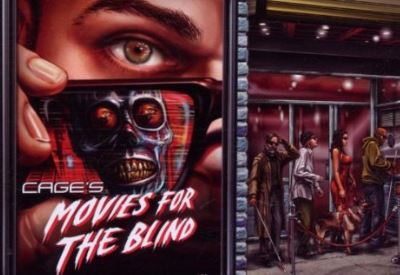
The first album on the menu is perhaps the least Halloween-flavoured of the bunch, but it’s got one foot firmly planted in the horror genre. Cage’s Movies for the Blind, released in 2002, combined shock rap with New York hip-hop in a way not many had attempted. Though he’s probably most notorious for a short lived beef with rap megastar Eminem, Cage’s first two releases are regarded by many as underground classics. Movies for the Blind started it all, and it’s a record that will leave you feeling utterly disgusted in the best way possible.

Lyrically, Movies for the Blind is the ultimate channeling of rage, drug abuse, and mental illness into bar after bar of tantalizingly shocking lines. Setting the tone is an album opener with Cage expressing an unbridled affinity for PCP and destruction. The album doesn’t quit either, with jump-scare like lyrics woven into even the most New York sounding tracks to keep you on edge. No content is off the table on this record. Murder, suicide, and violence find themselves as staples on what is a freak-show of atrocities. Dips into the norm are rare, but when they do happen it serves as a necessary break from the amazingly grotesque images Cage paints with his words.

Blue collar to corporate blessed the unfortunate,
Like when I put my foot down that bitch still aborted it,
Stuck the canister under my jacket like the lucky one,
‘Uh, sir you can’t leave with that,’ bitch this my fucking son!
(Too Much)

Unlike Hell’s Winter, which saw Cage take a more introspective approach to his music, Movies for the Blind lacks any form of self-awareness. It is an album with an emcee at his most unhinged, unloading rage and hate at anyone who will listen. It’s beautifully executed, and forces you to feel a level of discomfort that most horrorcore albums simply haven’t been able to achieve.

His charisma is also undeniable. It gets to the point that he nearly comes across as a sociopath.

I’m a suicidal failure, look my life’s a failure,
I can’t make it in rap, even my birth’s an error,
Do what I can to catch a quick death,
But I’m meant to be here and that’s the fuckin’ hell I live with.
(Suicidal Failure)

Interestingly, the production on Movies for the Blind is relatively subdue and typical for the underground New York scene at the time. The album featured production primarily by DJ Mighty Mi, but also the likes of El-P, Necro, and Camu Tao (plus a handful of others). With the lineup, it’s no surprise that the sound is so distinctly east coast. Movies for the Blind fools you into nodding along with the gritty production, while throwing lines about suicide and death in your face. The contrast is absolutely wonderful to experience; moreover, the instrumentals are brilliantly cohesive throughout.

Movies for the Blind may not be the ultimate Halloween record, but there are qualities to it that definitely make it a terrifying listening. It’s quite interesting how this album plays out like a series of short snuff films. It’s more disturbing than scary, but it remains as grimy today as it was 14 years ago upon release. Movies for the Blind is also a gem from a time where Definitive Jux and Eastern Conference (the latter of which would release the album) were just beginning to take over the New York underground scene. Whether you’re interested in records from that era, or just looking for something gory to celebrate Halloween, Movies for the Blind remains an underground classic that is wholeheartedly recommendable.

Not for the faint of heart, however.

Album Review: Danny Brown – Atrocity Exhibition

by Dustin

ae

9/10

If you’re a hip-hop fan and you don’t know who Danny Brown is, there’s a good chance you’ve been living under a rock since 2011. The Detroit emcee is known as quite the character, bringing an insurmountable level of energy to every song he touches. After jumping to Warp Records, Danny has finally released his follow up to 2013’s Old. Atrocity Exhibition.

And yes, that is a Joy Division reference.

On this record, Danny Brown is a rock-star in every sense of the term. He’s a boisterous character with no fear of expressing his affinity for drugs and alcohol; however, the beauty in Atrocity Exhibition is his ability to explore the consequences of the lifestyle he lives. Danny may be one of the few rappers who will boast about his drug use on one track, and then turn around and smack you with the honest truth about the problems this causes him on the next. Lyrically, he is completely on point. Atrocity Exhibition still has the same zany personality that made XXX and Old unique, but it’s also a highly introspective release. His lyrics are upfront and truthful, depicting a lifestyle that many couldn’t begin to imagine.

Everybody say, you got a lot to be proud of,
Been high this whole time, don’t realize what I done,
Cause when I’m all alone, feel like no one care,
Isolate myself and don’t go nowhere,
Smoking blunt after blunt, ’til my eyes start burning,
Hennessy straight got my chest like a furnace,
Drowning frustrations in a ocean of sin,
Thinking irrational, I have no emotions.
(Downward Spiral)

What stands out most about Danny Brown’s vocal performance on this record though is his flow. The man can rap on anything, plain and simple. For example, both the opening track “Downward Spiral”, and the song “White Lines” both have instrumentals that sound as if they should be impossible to ride… Yet, Danny finds a way to make it sound as easy as breathing. It’s really something to behold, and his ability to do this is on display here more than any previous album.

Which brings us to the instrumentation itself.

The production on Atrocity Exhibition is a really a unique experience. Provided by the likes of Paul White, The Alchemist, and a few others, the instrumentation on the album is unlike any other. There are elements to the production which feel distinctly Detroit, yet the overall sound is so off-the-wall that it’s hard to Atrocity Exhibition to any single influence. There are tracks like “Downward Spiral” that feel so heavily influenced by Joy Division (as the title would lead one to believe), and then more conventional instrumental like “Pneumonia”.

In the broader sense, everything works well together even with the vast stylistic variation. It feels hectic in a good way, and that’s exactly what’s to be expected from Danny Brown.

Atrocity Exhibition is special. It’s special first and foremost because it’s a great album, but there’s also something wonderful about seeing Danny Brown realize his potential. His previous releases have all been good in their own respect, but Atrocity Exhibition feels like so much more. It’s the type of album that pushes boundaries without being recklessly abrasive. Its execution is brilliant in the sense that it’s experimental, yet familiar enough to appeal to a larger base.

So my task,
Is inspire your future with my past,
I lived through that shit,
So you don’t have to go through it,
Stepping stones in my life,
Hot coals,
Walk with me.
(Hell for It)

Atrocity Exhibition may feel like a fever dream, but it is one that you will never want to wake up from. As a hip-hop fan, this record is a can’t miss album. Danny Brown has released one of the most engaging, unique, and gritty records of 2016. It’s certainly worth your time, and potentially album of the year material.

Album Review: Niku No Sekai – Flesh World Vol. 1

by Dustin

fleshworld

7.25/10

For nearly eight months we have regularly been reviewing albums here at Extraordinary Nobodies. Between our standard reviews of new releases, and the brand new “why was it good” retrospective category, it’s safe to say that we really love reviewing music. Yet, if one was to sort through our review archives they’d notice something odd… We have reviewed zero instrumental albums! This seems like a bit of a tragedy, as instrumental releases have been a big part of hip-hop forever.

Yet, the first instrumental album we’re going to have a look at isn’t even necessarily a hip-hop release! It is more of an ambient record, but it shares a lot of elements that instrumental hip-hop fans will be familiar with! This is particularly true for those who are interested in the alternative side of production. Plus, we do what we want. Fuck genres.

Moving on…

The album in question is Flesh World Vol. 1, a collaborative effort between two established artists (of SCRTS and Chinatown’s Pormer) released under the name Niku No Sekai. This project came out under the relatively young DOOMTRIP Records, a label which specializes in cassette based releases (you should follow them on twitter, sometimes they do awesome download code giveaways). Flesh World Vol. 1 was recorded on new years day, and saw release on DOOMTRIP in April.

So we’re a little behind the times here, but again, we do what we want.

Flesh World Vol. 1 is perhaps one of the most atmospheric releases to come out this year. The overall vibe to the tape is very chilled out, spacey, and slightly unnerving. It is not a long release by any means, but the sound is very cohesive throughout. Those who are already acquainted with ambient releases will most likely love Flesh World Vol. 1. It sounds like space. Listening to this album is like taking a trip through the galaxy while stoned.

The use of distance and beat changes on Flesh World really gives it life. Five tracks feels more like seven or eight, and there is a tangible environment with every second of playback. Though it’s ambient, the record isn’t afraid to grab your attention and force you to focus. The opening track, “WW4”, is a prime example of this. It has some really interesting switch-ups; moreover, the track is over ten minutes long but doesn’t feel dull for a second.

It is a dense piece of art. Don’t mistake “ambient” with “empty”, because this tape is immensely dense listening. Flesh World Vol. 1 is a record that will eventually demand your full attention, even if it does also make excellent casual listening. It is musically interesting enough to be much more than simply background noise. It certainly feels like there is a new sound to discover with every subsequent listen.

There are just so many things happening at once. It is a delightful and fun chunk of material to sink your teeth into.

For the hip-hop fans reading this blog wondering if they should give this tape a listen, yes, you definitely should. If you’re a fan of the stoned-out sound found in the cloud rap scene, this tape is probably going to be right up your ally. It’s a more developed sound as a product of needing to stand out without vocals, but there are clear similarities. Give it a listen, you probably will not be disappointed. Maybe you’ll even discover a new genre that you’ll enjoy.

Album Review: clipping. – Splendor & Misery

by Dustin

sm

8.5/10

It definitely seems as if we’ve written about clipping. a lot, but they’re one of the most active and unique rap groups out current. Who can blame us? Anyway…

To say that Daveed Diggs is popular right now would be an understatement. Fortunately, for fans of the Los Angeles based experimental rap trio clipping., he’s not abandoned his work in the world of weird. With an EP (Wriggle) already under their belt for the year, clipping. is back again with a full length followup to 2014’s CLPPNG. Released under Sub Pop Records and popular experimental outfit Deathbomb Arc, Splendor & Misery looks to keep clipping.’s hot-streak of releases at full steam.

With Splendor & Misery, clipping. took a step in a different direction from previous releases. The album follows the story of the sole survivor of an uprising, his life on an interstellar transport ship, and his relationship with the on-board computer. The concept is unique, and provided Digg’s the opportunity to flex his storytelling ability at every turn. He flawlessly maneuvers over the wild production, proving time and time again that he is one of the more versatile emcees in hip-hop. Tracks like “Baby Don’t Sleep” are beautifully unnerving, and it big part of this is Daveed’s vocal control and delivery. All in all, a wonderful vocal performance throughout the entirety of Splendor & Misery.

No home, you’ve been there,
Clearly off safety,
No destination,
No time for waiting,
Saviors are fiction,
Memories fading,
like ghosts, ghosts, go.
(Baby Don’t Sleep)

The production is basically what is to be expected from a clipping. album. It’s abrasive, loud, and fuzzy. The main difference on Splendor & Misery is that the instrumentals tend to be more spaced out than a lot of their previous work. Given the concept of the album, this is completely understandable and sets a well defined mood behind Deveed’s vocals. Atmosphere is the main strength of the production on this album. Though it might not necessarily carry that touch of traditional hip-hop the group is known for, the instrumentation is well execute. Hudson and Snipes rarely disappoint.

Though the album is a fantastic piece of art-rap, Splendor & Misery does have one minor flaw. There was a single moment which did not feel as though it fit the overall sound of the record. “Story 5” . Coming off a long run of incredibly cohesive work, the acapella felt very out of place. Unlike the previous “story” tracks on clipping. releases, it was not a standout track; regardless, It is still a pleasant listen and quite interesting, but in the grander picture of Splendor & Misery it was a jarring shift in sound.

Listeners who go into Splendor & Misery expecting the heavy hitting blend of conventional rap and noise may be in for a bit of a shock. This album is definitely a departure from the norm for clipping. as a group. Splendor & Misery should be approached as a conceptual art album, and not put in the same category as their previous works. Fortunately, for those who find themselves missing the sounds clipping. played with on previous releases the EP from earlier this year is jam packed with heavy, easier to digest songs.

This ain’t healthy to be held to blame,
Once you help me, now you abandon me,
What you’re tellin’ me by not tellin’ me?,
Anything, anything,
I’d give anything if you’d say my name,
Don’t you play with me, it’s an emergency.
(Break the Glass)

Don’t discredit Splendor & Misery for that reason, however. This album seems to be the moment that clipping. really discovered who they are as artists. From a conceptual standpoint this is the groups strongest effort. It was an absolute treat to see them tapping into some hidden potential. They took a risk with a release that is unconventional even for clipping., and it paid off with a solid final product.

Album Review: Ka – Honor Killed the Samurai

by Dustin

HKTS

8.75/10

It seems as if Ka has been on a roll since his debut solo album release in 2008. The gritty Brownsville emcee has totaled three solo albums (prior to Honor Killed the Samurai), two extended plays, and a collaborative album under the name Dr. Yen Lo. All have been met with positive critical reviews, and have garnered him an impressive underground fan base. As mentioned, he’s recently released Honor Killed the Samurai. This is his first full length solo album since 2013’s The Night’s Gambit, but he’s kept fans eagerly anticipating it with collaborative efforts and a handful of singles.

It’s finally here however, and it definitely lives up to the standard Ka has established throughout his discography.

When approaching any of Ka’s work, it should be expected that you will have to rewind and replay tracks multiple times to catch all the little details. This is true for Honor Killed the Samurai. With the focus being primarily on story telling lyrics, it isn’t the type of album that one can digest quickly. There is a lot of meat to chew on, and honestly this makes it quite wonderful to revisit. Ka’s presence on the album is most similar to that of a spoken word poet.

I strained to obtain so I could give more,
Most dangerous when there was nothing to live for.
(Conflicted)

Additionally, the production on Honor Killed the Samurai provides a splendid backdrop. The instrumentation feels relatively minimal; however, it’s quickly evident that it was the perfect choice for the overall feel of the album. There’s a degree of consistency to the production that creates a wonderfully cohesive environment behind Ka’s vocals. Though the production is minimalistic, it is a beautiful simplicity. All the tracks sound smooth, there is not an abrasive moment in the duration of Honor Killed the Samurai.

At the end of the day, Ka is the definition of a rapper’s rapper. Those obsessed with storytelling and complex (yet coherent) rhyme schemes will fall in love with this album. He’s immensely talented at painting a vivid scene, and he oozes technical writing ability. That being said, if you’re looking for an absent minded listen (which there is absolutely nothing wrong with), this is not the album for you. The focus is so narrowed on vocals that the listener has to be prepared to pay attention. It’s a rewarding listen, but not an easy one.

So I stood on mine, during the hoodest time,
Was a nightmare, felt like life here was as good as dying,
We was born in the thorns, few arose,
Once a town’s noose, now in soundproofs pursuing golds.
(Mourn at Night)

In a moment of stunning unprofessionalism, it seems fitting to close this with a statement aimed at the New York Post. If you cannot separate the music of a highly regarded story-teller from their personal lives, that is your issue. Do not attempt to write a smear piece on the artist. Simply because Ka writes about things street relate (perhaps things he’s seen, or grown up around), does not make him any less of a firefighter. He’s doing a job most are not brave enough to do, and should be celebrated as such. Not shamed for producing art that many love.

To the fans who voiced their displeasure, kudos. The author at the New York Post showed so little journalistic integrity, and it was beautiful to witness fans standing up for an artist over an injustice. Hopefully those who stood up for Ka also go out and support this project. Honor Killed the Samurai is very much worth the purchase.